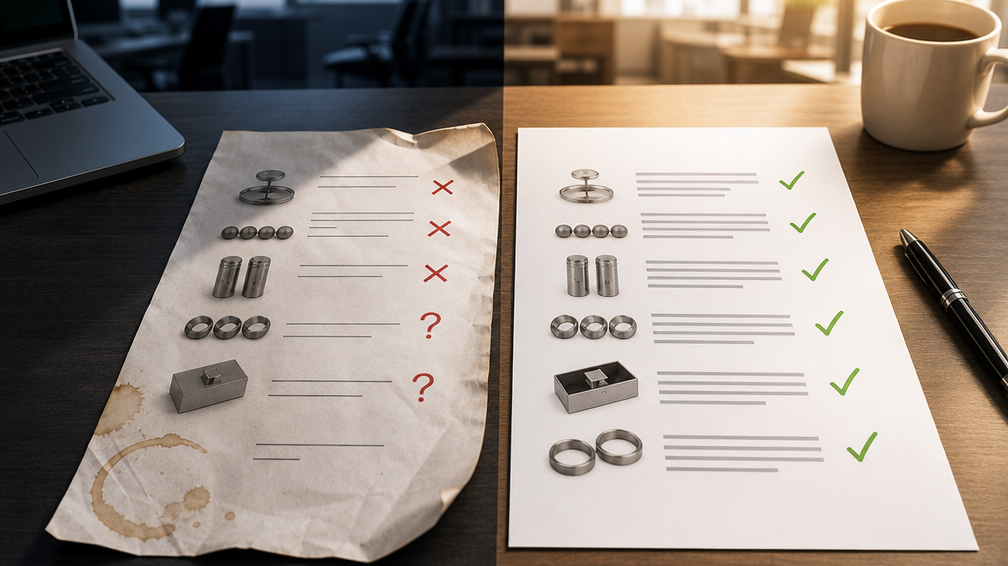







Last week, we walked through the six phases between sending a brief and holding a first sample. This week is the companion piece: the specific gaps in a brief that push a project into the slow, expensive version of that timeline instead of the fast one.
None of these mistakes are complicated to avoid. They're just easy to miss when you're briefing a project quickly, or when you're used to a different category of sourcing where these details matter less. Here's what actually slows a metal giftware project down at the brief stage — and what to include instead.

Mistake 1: Leaving Tolerances Undefined
A brief that specifies overall dimensions but not tolerances leaves a manufacturer to guess at how precise you actually need the finished piece to be — and manufacturers who guess tend to guess conservatively, which usually means a more expensive process than necessary, or a first sample that doesn't match your actual expectations because the guess went the other direction.
If you don't know what tolerance your design needs, that's a fair starting point to raise directly rather than skip. A good supplier will help you figure out what precision actually matters for your specific piece, rather than either assuming or ignoring the question.

Mistake 2: Describing a Finish Instead of Specifying It
"Brushed finish" and "premium matte look" describe an impression, not a specification. Different manufacturers — and different production lines within the same manufacturer — will interpret those phrases differently, which means the sample you receive may not match the mental image you had when you wrote the brief.
Reference photos, finish sample codes if your supplier has a standard set, or a request to see physical finish samples before committing all reduce this gap significantly. It's a small amount of extra effort at the brief stage that prevents a full sample revision cycle later.

Mistake 3: Omitting Volume and Cadence
A brief that states a quantity but doesn't clarify whether that's a one-time order or the first of a recurring cadence leaves a supplier quoting and planning for the wrong scenario. Tooling decisions, pricing structure, and even which production line a job gets assigned to can depend on whether a supplier is planning for a single run or an ongoing relationship.
This is also information suppliers generally want to know regardless of how it affects your quote — a supplier planning capacity around a real reorder relationship, versus a one-off, is more likely to prioritize your project appropriately over time.

Mistake 4: Treating Timeline as a Single Date Instead of a Real Constraint
"We need it by [date]" is necessary but incomplete. What actually helps a supplier plan is knowing whether that date is a hard external deadline — a trade show, a contractual delivery commitment — or a soft internal target with some flexibility. These require different levels of buffer, different willingness to expedite at a cost premium, and different honesty from your supplier about whether the date is realistic at all.
Buyers who share only a date, without context on how firm it is, often get a timeline quoted with hidden padding — because the supplier has no way to know whether missing it by a few days is a minor inconvenience or a genuine problem.

Mistake 5: Not Mentioning Packaging and Shipping Requirements Upfront
Packaging is frequently treated as an afterthought in a brief, addressed only once a sample is already approved. This is a mistake specifically because packaging requirements — retail-ready packaging, bulk export cartons, specific labeling or compliance markings — can affect production line decisions and cost structure in ways that are much cheaper to account for from the start than to retrofit later.
If your project has any packaging requirements beyond generic bulk shipping, include them in the initial brief, even in rough form.

Mistake 6: Giving a Total Budget Instead of a Per-Unit Range
A total program budget tells a supplier what you can spend, but not what tradeoffs are acceptable at the unit level. A per-unit price range — even an approximate one — allows a supplier to have an honest conversation with you about where cost can be optimized (material, process, finish) versus where it shouldn't be, rather than either overengineering a quote to be safe or underdelivering to hit a number.
This is one of the most common gaps we see, and one of the easiest to fix: buyers are often more willing to share this than they assume, once they understand it leads to a more useful conversation rather than a worse negotiating position.

Mistake 7: Assuming the Supplier Will Flag Every Gap
Even a thorough manufacturer's feasibility review checks for whether a design can be produced — not necessarily surfacing every assumption a buyer might be making that differs from what the supplier assumes. A brief with genuine ambiguity may get quoted and produced according to a reasonable interpretation that isn't actually the one you intended, without anyone realizing there was a gap until the sample arrives.
The practical takeaway: don't rely entirely on your supplier to catch what's missing. Treat their questions as a starting point, not a complete safety net.

A Quick Self-Check Before You Send a Brief
- Have I specified tolerances, or at least flagged that I need help determining them?
- Is my finish description backed by a reference, sample, or specific code — not just a descriptive phrase?
- Have I clarified whether this is a one-time order or a recurring cadence?
- Does my supplier know whether my deadline is hard or flexible, and why?
- Have I mentioned packaging requirements, even roughly?
- Have I given a per-unit budget range, not just a program total?
A brief that answers these questions before it's sent tends to move through the timeline we covered last week considerably more smoothly — fewer clarification rounds, fewer surprises at the sample stage, and a supplier who can plan accurately from day one.

Getting This Right the First Time
If you're not sure which of these gaps apply to your specific project, that's a normal starting point — most buyers aren't full-time sourcing professionals, and a good supplier should be able to help you fill in the gaps rather than penalize you for not having all the answers upfront. We're glad to review a rough brief and tell you honestly what's missing before it becomes a costly gap later in the process.